


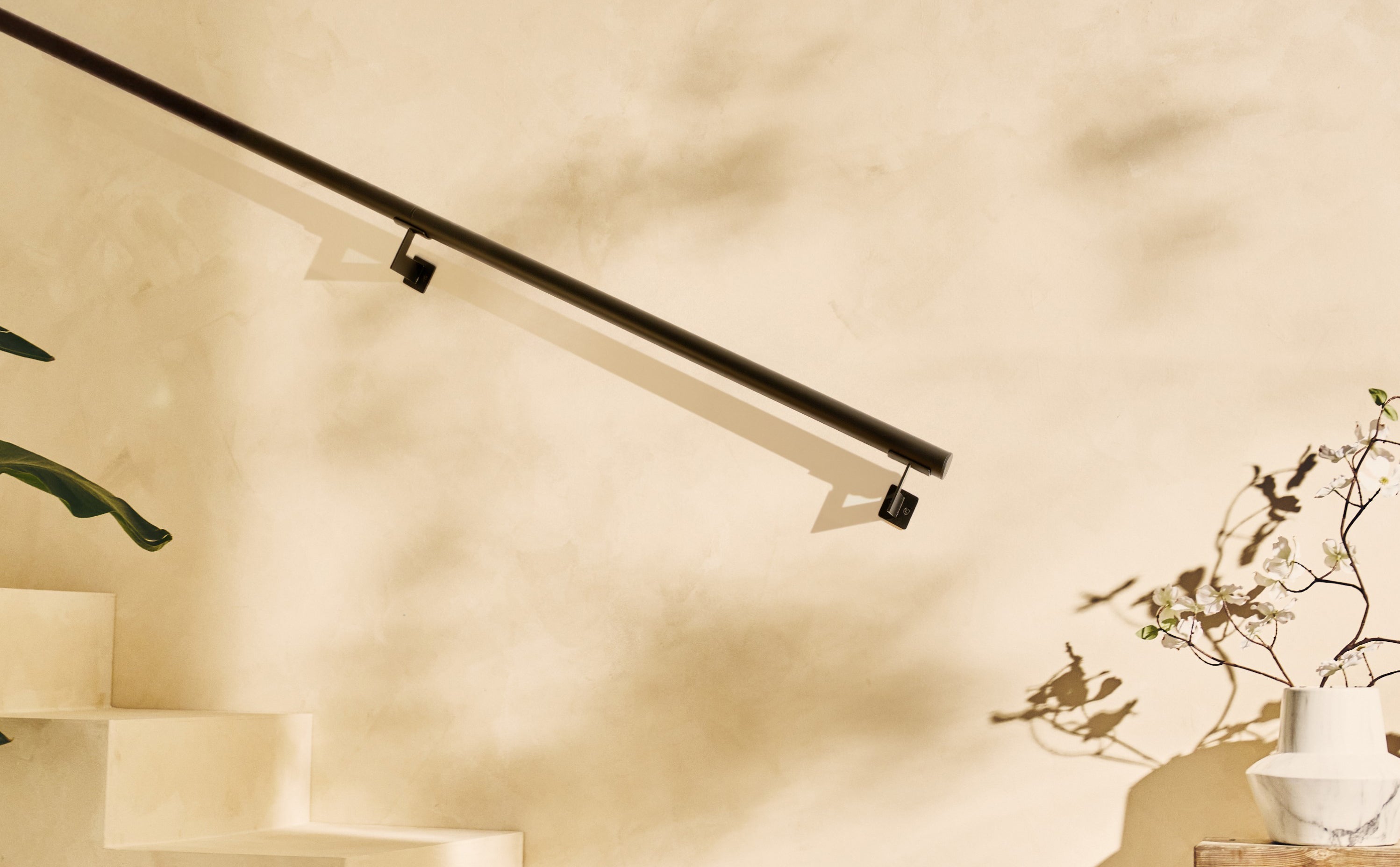
A handrail is one of those things that you only think about when it’s missing or no longer holds properly. Yet it provides more safety every day. When climbing stairs with full shopping bags, when children conquer the first steps on their own, or when parents and grandparents wish for some additional support.
We believe that safety at home should be easy to implement. That’s why we have designed our handrails for stairs and handrail brackets so that you can install them yourself without professional knowledge. With a little preparation, the installation can often be completed in an afternoon, saving you the cost of a tradesperson.
01. Why a handrail is worth it
A handrail for the stairs not only makes your railing safer but can also change the appearance significantly. Depending on the material and color, it adapts to your living style or sets deliberate accents. Stainless steel looks minimalist and modern, black fits the industrial look, and white blends unobtrusively into light staircases.

Our tip: As soon as the handrail is permanently exposed to rain or moisture from the outside, we recommend handrails made of metal in stainless steel or powder-coated. The material is robust, rust-free, and the first choice for outdoor stairs, balconies, or damp areas – ideal as railings outside.
02. Choose the right handrail and handrail holder
A handrail system consists of two components:
-
Handrail holders (also called handrail supports or handrail brackets), which are attached to the wall
-
Handrail, which you will hold onto later
Our handrail holders are available in various designs, for example EDGE, FLEX, ROUND. Depending on the model, they fit a square or round handrail made of wood such as oak or beech, PVC, or a rope. Our models EDGE and ROUND are particularly well-suited as handrail supports for wood.
The easiest way is to first choose the style that matches your home. Then, you combine it with the appropriate handrail. Our classics are OBLONG (box profile) or TUBE (Round tube). So in the end, everything fits perfectly together depending on the style of furnishing.
Tip: Our handrail holder FLEX can be adjusted in inclination and provides particularly much flexibility during installation.

03. The right height and appropriate distance
Before you start drilling, you should determine three measurements.
The right height
Handrails are usually mounted between 85 and 100 centimeters above the edge of the step or standing surface in private residential buildings. This allows for comfortable gripping of the handrail and provides secure support.
In public or commercially used buildings, different regulations may apply. Inform yourself here about the applicable regulations before installation.
The appropriate length
Every house is different, and your railing should still be continuous, without gaps or interruptions in inconvenient places. That's exactly what our handrails are made for: you can connect and extend them as needed, so that in the end, you achieve exactly the length your staircase needs, whether it's a short landing or several floors in a row.
The ends also deserve attention: they should be designed so that no one gets caught or injured on them. It is most sensible to extend the handrail slightly beyond the beginning and end of the stairs. This provides additional support when ascending and descending. For a clean, safe finish, we even include the appropriate end caps as standard.
Distance of the handrail holders
To keep the handrail stable, we recommend a holder for the handrail approximately every 80 to 100 centimeters, as well as one handrail holder at the beginning and at the end.

Our tip: It's better to plan one more holder than one too few. This way, the handrail remains stable even under higher loads.
04. What you need for installation
For installation, you only need a few tools:
-
Drill
-
Appropriate drill bit for your wall
-
Level, measuring tape, pencil
-
Screwdriver or cordless screwdriver
-
Dowels and screws
Good to know: With our handrails, the appropriate mounting material for concrete walls is already included in the delivery, including railing brackets and metal railing accessories for concrete. This way, you have everything you need for the installation right away.

05. Installation made easy
Step 1: Mark the height
Starting from the front edge of the step, first mark the height of your brackets. Pay attention to the difference between the handrail and the drill holes.

Pro tip: Using a cross-line laser makes marking particularly precise.
Step 2: Determine the position of the brackets
Mark the first and last bracket as well as all other brackets at equal intervals.
Step 3: Choose the appropriate dowels
Not every wall is the same. Concrete, solid bricks, drywall, or wood require different dowels and screws. Always use fastening materials that are suitable for your wall material. Only then will the handrail have a secure hold permanently.
Step 4: Attach the handrail brackets
Drill the holes, insert the dowels, and screw the brackets firmly to the wall. Then check whether all brackets are stable and properly aligned.
Step 5: Install the handrail
If necessary, cut the handrail to the desired length and then attach it to the brackets. Finally, check that everything is tight and nothing moves.
Done! Your new handrail is ready for use.

These are the most common mistakes during installation
With a few simple tips, typical mistakes can be easily avoided.
-
Too few brackets: The handrail can bend or wobble.
-
Incorrect dowels: Especially with hollow walls or drywall, the right fastening material is crucial.
-
Incorrect mounting height: A handrail mounted too high or too low is uncomfortable, offers less safety, and may not comply with standards in the worst case.
-
Inappropriate combination: Ensure that the handrail and handrail brackets match each other.
Three application examples
Indoor stair railing:
Handrails in black or white fit most home styles. Depending on your taste, you can choose different holder shapes, for example WIDE for a striking design or SLANT for a simple look.
Stair railings outside or on the balcony:
For this, we recommend metal in stainless steel or powder-coated. The material is rust-free, weather-resistant, and easily withstands rain and moisture. Particularly suitable, for example, is our Handlauf OBLONG combined with the handrail holder EDGE.
Also without stairs:
A handrail is not only suitable for stairs. It also provides additional support and more safety in everyday life in the hallway or entrance area, for example for older family members. For a discreet look, we recommend our Handlauf TUBE with the handrail holder ROUND.
Your stair railing, your pace
A handrail is a small change with a big impact. It makes your home safer, provides more comfort in daily life, and simultaneously enhances the visual appeal of your stairs.

At Natural Goods Berlin you will find a large selection of handrails and handrail holders that combine style, functionality, and quality. Whether black, white, or stainless steel: choose the right shape and material for your stairs and get started with your next DIY project.
Discover handrails & handrail holders now →
Share:
How do I properly set up my Home office?
Choose & install curtain rods: The complete guide